Movement & survival guide
The most useful response to danger is a better route. Learn the next landing, keep your movement connected and use the quiet rooms to prepare.
In this guide
Carry movement through the jump
The game’s director describes a fixed maximum movement speed and momentum that carries into a jump. Think in connected movements: takeoff, flight, landing, then the next action. Stopping to line up every small step can make a flowing route feel more complicated than it is.
For a difficult gap, pick a takeoff reference you can recognize on the next attempt. Keep that reference constant while changing one part of the jump. If every attempt begins somewhere different, it is harder to tell whether the problem was the launch or the correction.
Correct the landing while airborne
You can adjust left or right in the air and pull back when you have overshot. A jump is not finished at takeoff: watch the landing surface and use the rest of the flight to make the correction.
Look at where your feet need to arrive rather than only at the hazard below. If you repeatedly pass beyond a platform, try less forward commitment or an earlier pullback. If you consistently miss to one side, change the sideways correction first. These are useful experiments to make separately.
Read the route as a chain
Runs, slides, wall runs, ledge grabs, clambers and swings belong to the same movement vocabulary. A wall or ledge may be a continuation of the route rather than a place where you should stop.
Before a retry, name the next two actions in plain language: for example, jump to the ledge, then turn toward the next support. Keeping the sequence short makes it easier to recover when the camera or pursuit pressure distracts you.
Chase, arena or exploration?
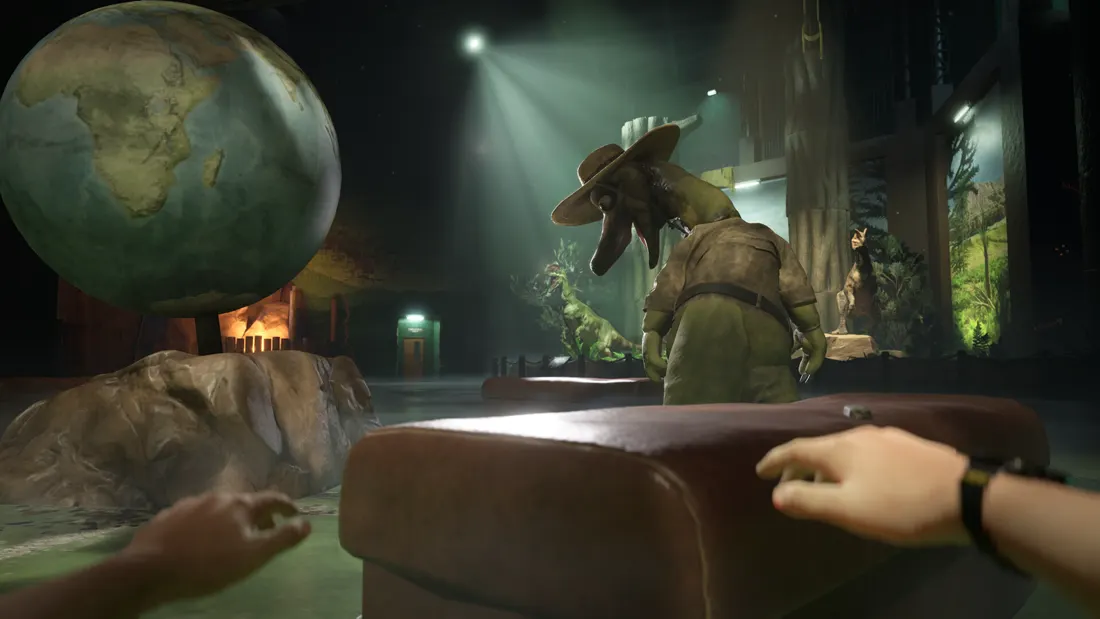
These sections test different things. An arena can ask you to complete several objectives while avoiding a creature; running without a task in mind can take you in circles. A chase rewards recognizing the next route segment. Use the chapter guide to identify which kind of problem is in front of you.
| Situation | Your immediate priority |
|---|---|
| Direct chase | Keep advancing through the traversal route. |
| Open arena with a roaming threat | Work out which objective can be completed on the next pass. |
| Quiet exploration | Read the room, inspect the route and search for optional story material. |
Sources & further reading
Movement design · John W. Gelardi, PlayStation Blog · Movement Is Your Weapon · Xbox Wire · Developer launch overview